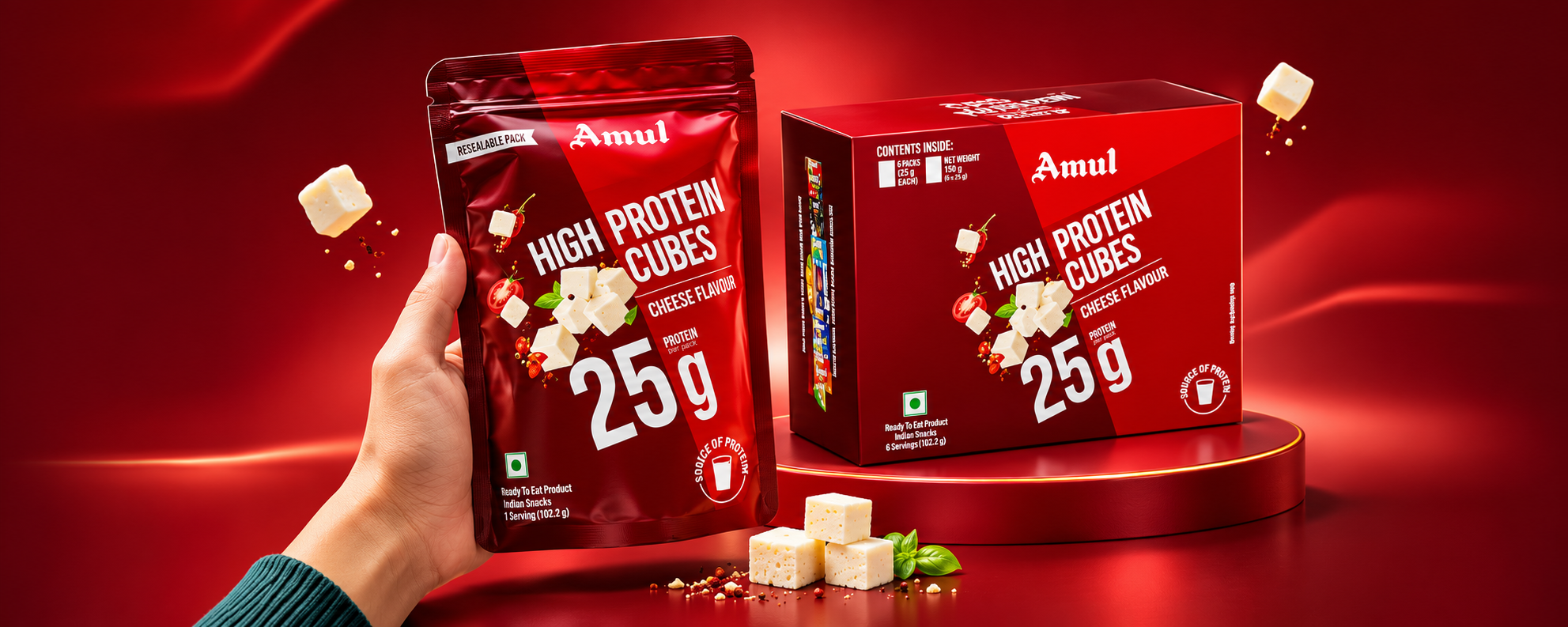
Amul high protein cubes: What the launch teaches brands about testing a protein snack?
Amul High Protein Cubes pack 25g of protein into an ₹80 pack. What the launch shows about India’s protein snack market, and how brands should test one first.
In brief
Amul High Protein Cubes are a crunchy, ready-to-eat snack with 25g of protein in a 38g pack, priced at ₹80. Amul launched them online first, with a limit of two boxes per order, and they sold out on the day of launch. That works as a live test of demand before a wider rollout. For other brands, the launch raises the questions every protein snack faces: Which claim sells, what price works, which flavours to keep, and when people will actually eat it. Each of these can be answered with consumer research before launch rather than after.
What are Amul High Protein Cubes?
Amul High Protein Cubes are a savoury snack made from milk protein. Each 38g pack has 25g of protein, or 65%, with 150 kcal, and costs ₹80 (Amul).
- Flavours: A box of five packs comes with five seasoning sachets: Peri Peri, Korean Kimchi, Tandoori, Cheese & Herbs and Tomato (Amul).
- How it’s eaten: The cubes can be eaten as a snack, added to gravies, used like croutons in soup, or made into a protein bhel (Amul).
- Positioning: Coverage has framed it as a crunchy alternative to protein shakes (Business Today).
- Development: Amul’s brand manager said the product took more than a year to develop (Indian Opinion).
Why is Amul launching a protein snack now?
Amul is launching a protein snack because demand for protein-rich food in India is growing, and most packaged snacks are high in carbohydrates and low in protein (Dairy News Today, Indian Opinion).
The cubes extend a high-protein range Amul began in 2022, which now covers paneer, dahi, lassi, buttermilk, milkshakes and whey protein (Startup Pedia). They also take Amul into a new space: Savoury, ready-to-eat snacking, where people eat out of the pack rather than with a meal.
Is Amul’s limited launch a demand test?
Amul’s launch works as a demand test. Amul announced the cubes on 30 October 2026, and buyers replying to the post on X said they were already out of stock the same day (Amul on X). The product has stayed marked as sold out on Amul’s online store (Business Today). Orders are limited to two boxes, which suggests Amul is checking demand before committing to mass retail (Indian Opinion).
A sell-out proves people will try a product. It doesn’t show why they bought it, whether they’ll buy again, or what would bring in the shoppers who held back. Amul has the reach and loyal following to learn this from a live launch. Most brands don’t, so they need consumer research before launch to answer those questions without the risk.
How should brands test a new protein snack?
Brands should test a new protein snack by asking real buyers four questions before launch. The Amul cubes make each one concrete.
| Question | Amul example | Research method |
|---|---|---|
| Which claim sells the product? | 25g protein, 65% protein, or only 150 kcal | MaxDiff, to rank claims by importance |
| Is the price right? | ₹80 a pack, ₹400 for a box of five | Price testing or conjoint analysis |
| Which flavours should stay? | Five flavours in every box | TURF analysis, to find the line-up that appeals to the most buyers |
| When will people eat it? | Snack, gravy, soup or bhel | Usage survey of target buyers |
Claims: “25g protein” and “65% protein” describe the same thing in different ways, and one will almost always land better with buyers. MaxDiff shows which, so the pack leads with the stronger claim.
Price: Conjoint analysis shows how much more buyers will pay for extra protein, and whether a single pack or a box of five feels like better value.
Flavours: Most brands can’t afford to make five flavours. TURF analysis finds the two or three that together reach the most buyers.
Occasions: A snack eaten from the pack competes with chips and namkeen, while one added to gravies competes with paneer. Knowing which occasion wins decides where the product sits on the shelf and who it is advertised to.
What can brands expect from India’s protein snack market?
India’s protein snack market is likely to become more crowded and more demanding through 2026 and 2027. Four trends are worth planning for:
- More formats beyond shakes: Big dairy brands are moving protein into snacks, so new brands will compete on format and taste, not just protein content.
- ₹80 as a price reference: Amul has set a visible price for 25g of protein in a snack, and shoppers will compare other products against it.
- Savoury and local flavours: Flavours like Tandoori and Peri Peri show protein moving towards Indian snacking tastes and away from gym-style sweet flavours.
- Quick commerce as the next battleground: Protein snacks are impulse buys, so availability on Blinkit, Zepto and Instamart will matter as much as the product itself.
Testing your protein snack on Flickly before you launch it
Flickly helps food brands test new products before launch, using concept tests, MaxDiff, TURF, price testing and conjoint analysis. Studies run on a panel of more than 65 million verified consumers, every response is scored for quality, and findings arrive in 72 hours.
Frequently asked questions



Run your next study with verified Indian consumers
Design the study, reach the right respondents, and get decision-ready insights in 72 hours.